PAPER CUT
for wind band,
recycled printer paper,
and prerecorded audio.
Composed by Alex Shapiro (ASCAP).
2010; Revised 2025.
Duration 5:00.
PAPER CUT is published by Activist Music LLC (ASCAP), and distributed by Hal Leonard and Activist Music LLC.
Grade 3 and beyond.
This piece is adaptable, and well suited for ensembles needing flexible instrumentation.
|

|
| |
Click the arrow below
to listen to a recording by the
University of Minnesota Symphonic Band,
Craig Kirchhoff, conductor.
|
|
| |
|
|
| |
PAPER CUT is available as a
physical, bound set of score and parts
plus audio download,
or as a digital set of .pdf score and parts,
plus audio download.
Full set: $80.
Score only: $15.
|
|
|
Click here to order from Activist Music:
|
|
|
Click the icon to order
from Hal Leonard:
|
|
|
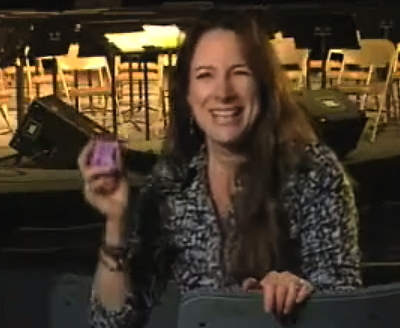
A still from a video interview in which Alex describes
how to be a virtuoso paper player!
|
|
Welcome! Here's a page filled with helpful information and materials for Alex Shapiro's electroacoustic band piece, PAPER CUT. Sit down and enjoy the long scroll!
If you have purchased the piece and need the audio tracks, please CLICK HERE TO EMAIL ALEX SHAPIRO, and you will receive an email with the download links and all related information!
Enjoy exploring this page, and email Alex to let her know if you perform the piece-- she loves to hear from people!
|
|
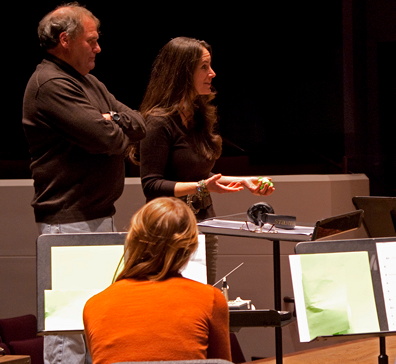
PAPER CUT conductor Craig Kirchhoff and Alex,
crumpled ball of paper in hand on October 2010,
at the University of Minnesota recording session.
|
Alex is proud to have been the 2010 commissioned composer for the longstanding American Composers Forum BandQuest series, made possible by a grant from the National Endowment for the Arts.
PAPER CUT, Alex's ground-breaking, first-ever electroacoustic work for middle school band, sounds like an action film and has students performing on printer paper as well as on their instruments. The piece was premiered May 25th 2010 by the Friday Harbor Middle School Concert Band on San Juan Island, WA, with Janet Olsen, director.
Launched into its second printing in less than a year, PAPER CUT rapidly became the top selling piece in BandQuest's distinctive decades-long history, and has been performed thousands of times all over the world by musicians of all ages!
|
| Commissioned by The American Composers Forum for its BandQuest series.
PAPER CUT is published by Activist Music LLC (ASCAP), and distributed by Hal Leonard and Activist Music LLC.
|
|
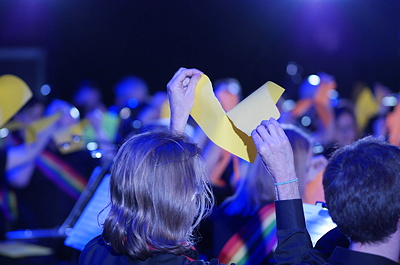
PAPER CUT performance photo: Annemarie Bain.
|
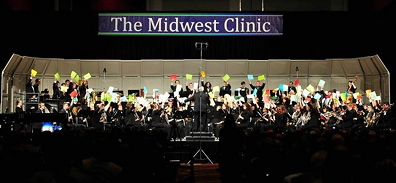
PAPER CUT ripped it up at the 2011 Midwest Clinic!
|
|
The VanderCook College of Music Symphonic Band, conducted by Charles Menghini, performed PAPER CUT on December 16, 2011 at the Midwest Band and Orchestra Clinic held at McCormick Place West in Chicago, Illinois.
Listen to an excerpt of PAPER CUT
from
the live performance:

Conductor Charlie Menghini writes:
"Paper Cut is a must for any director wanting to expand the musical horizons of their ensembles. A crowd pleasing work, every young band needs to add this to their repertoire as soon as possible. Your crowds will LOVE it...and so will your students. Enjoy and BRAVO to Alex Shapiro for this great addition to the educational band repertoire."
|
|
|
PAPER CUT is among the pieces on VanderCook College's 2011 CD, The 65th Annual Midwest Clinic, on Mark Records. Click CD for more info. |
Recording credits:
The University of Minnesota Symphonic Band was recorded on October 29th, 2010 at Ted Mann Concert Hall, with Craig Kirchhoff, conducting.
Alex Shapiro, electronics and mix engineering.
Jerry Luckhardt, session producer.
|
|
PERUSAL SCORE
(email Alex for code access)
Not for performance or duplication. |
.pdf file of the TRANSPOSED CONDUCTOR SCORE,
9 x 12; 32 pages including cover and notes.
|
|
Zoom, Google Meet, Microsoft Teams, Webex, etc. are a wonderful tool for affordably bringing Alex into your rehearsal of PAPER CUT, without having to book a plane flight! She has a great time coaching students on becoming expert paper players, and the difference between their musicianship at the beginning of the rehearsal and that by the end less than an hour later, is remarkable. Best of all, webhearsals connect musicians to the real person-- and the funny stories-- behind the notes (and shreds) on the music stands.
The
best way to reach Alex is
through email,
by clicking here 
To see some examples of webhearsals, and the view Alex loves to share from her desk, click here.
|
|
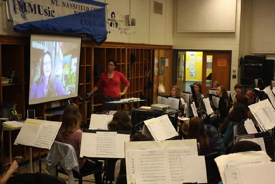
A December 2012 webhearsal with Alex
in her studio on San Juan Island, and band director
Mary Bauer and Mt. Mansfield Union High School
in Vermont, rehearsing PAPER CUT.
|
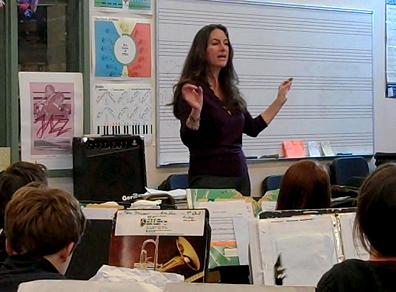
Alex in rehearsal for the very first performance of PAPER CUT,
with the students at Friday Harbor Middle School
on
San Juan Island, Washington.
|
Program note for Paper Cut
What do teenagers like? Video games, TV, and movies.
What do all these media have in common? Music!
With a desire to compose something relevant to younger players, I decided to create a piece that sounds somewhat like a movie soundtrack, to which the musicians can imagine their own dramatic scene. I also thought it would be fun to make the musicians themselves part of the action, so PAPER CUT has the band members doing choreographed maneuvers that look as compelling as they sound. In fact, no one plays their instrument until halfway into the piece!
When I told the commissioners about my plans to include an audio track as well as turn the musicians into paper percussionist virtuosi, I apologetically noted that this very weird piece would probably sell three copies, and thanked them for being willing to take a chance with me on this silly exploration. None of us had any idea that the first multimedia electroacoustic piece for middle schoolers would soon become such a familiar offering in the repertoire.
Music isn't just melody; it's rhythm, texture, and sometimes optics as well. The unusual element of paper and the myriad sounds and visuals that can emerge from something so simple offer a fresh view of what music-making can be, and opens everyone's ears to the sonic possibilities found among everyday objects.
With a nod to environmentalism, PAPER CUT also serves as a reminder to avoid waste by recycling. Players are encouraged to collect paper that would have otherwise ended up in the trash, and bring it to rehearsals. The piece might even be therapeutic, as students can take out their aggression by ripping up bad grades and test scores!
Although PAPER CUT was composed with middle schoolers in mind, it's equally suited to more advanced musicians, since the paper techniques and the skill of playing against a prerecorded track are interesting for all ages. It's also well suited to ensembles with varying personnel, due to the significance of the audio track.
I was delighted in 2010 to introduce a new approach to wind band repertoire, and after thousands of performances of this piece by students and adults around the world, I'm grateful that conductors and band members appear to have as much fun with this music as I had creating it!
Alex Shapiro
San Juan Island, WA
December 2025
|
|
The Chesterton Middle School 8th Grade Band, Vince Arizzi, director. May 21, 2024 in Chesterton, Indiana.
|
|
See the creative black-light treatment that band director Peter Guenther came up with when his students in the Owatonna 9th Grade Band performed "Paper Cut" at the Minnesota Music Educators Association Mid-Winter Clinic, at the Minneapolis Convention Center on February 18th, 2011 (the first edition of the piece had a tempo of quarter = 88, heard here, and was later changed to quarter = 96):
|
|
(please note: the first edition of the piece had a tempo of quarter = 88, heard here, and was later changed to quarter = 96).
|
|
Peter Guenther started a trend! Here's another choreographed, black-lite performance of "Paper Cut" all the way from Singapore, with the Singapore American School Tiger Band conducted by Brian White, in May 2011 (the first edition of the piece had a tempo of quarter = 88, heard here, and was later changed to quarter = 96):
|
|
West Aurora Blackhawk Band, John Sierakowski, conducting. October 20, 2015 in Aurora, Illinois.
(please note: the first edition of the piece had a tempo of quarter = 88, heard here, and was later changed to quarter = 96).
|
|
Want some advice for setting up your own black light performance? Here is a helpful guide from Peter Guenther:
|
|
SEE IT IN COLORFUL LIGHT!
|
Delaware Hayes High School Band, Andy Doherty, conducting. May 2021, in Grove City, Ohio.
|
|
Jackson Middle School Symphonic Winds, Jonathan Rehmert, conducting.
February 5, 2018, at OMEA (the Ohio Music Education Association)
conference at Capital University.
|
|
On October 16, 2022, the University of Alberta Concert Band teamed up with the honor band from École Archbishop MacDonald High School, and the result was a powerful performance of PAPER CUT--including many musicians playing from the balconys!--under the direction of conductor Meijun Chen. Here's the last half of the piece:
|
|
Here's an adult band, the Queer Big Apple Corps, conducted by Kelly Watkins,
performing at Symphony Space in New York City, April 2015:
|
|
SEE IT FROM
THE MUSICIANS' PERSPECTIVE!
|
Keokuk High School Symphonic Band, Jesse Deese, conducting. March 3rd, 2023, All-City Band Concert, Keokuk, Iowa.
|
|
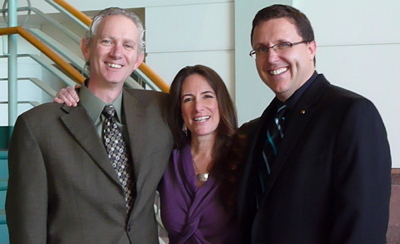
Alex flanked by University of Minnesota conductor and
PAPER CUT recording producer
Jerry Luckhardt, left,
and
Owatonna High School band director Peter Guenther, right.
|
NOTES, CURRICULUM,
and TECH GUIDES
|
Click on the icon at right for the Paper Cut instrumentation list, program notes, rehearsal suggestions, and a diagram of the audio setup. See what this piece is all about!
Please note that this is a REPLACEMENT for the notes published with the 2010-2024 editions of the score set, and we encourage you to download it. And, should you have the first edition of the score (a collector's item!), please substitute any references to "quarter = 88," with "quarter = 96".
|
|
Click the zip file icon at right to download the wonderful curriculum materials which BandQuest developed for PAPER CUT. These include rhythm practice and warm-ups, three lessons for creating music, interdisciplinary lessons and readings, and assessment strategies.
|
 |
Please note: tempo change!
In late 2013, Alex Shapiro decided to slightly adjust the tempo, and speed the track up from quarter note = 88, to quarter note = 96, to make the music even more exciting and fun to play.
Subsequent published editions of PAPER CUT include the markings for the new tempo and track timings; nothing in the music itself has been altered. The total performance time is now 5:00.
If you purchased the first edition of PAPER CUT, the pdf to the right includes a list of the changes that can be entered into your conductor score.
|
|
TECH SETUP:
Here's something VERY useful: a complete guide to the software and hardware setup for your ensemble room and performance venue.
|
|
RECORDING INFO:
For musicians making a virtual performance recording of their part at home: here's a guide to basic recording and filming techniques!
|
|
MIXING INFO:
For anyone mixing all the files for a virtual performance recording: here's a guide to basic mixing techniques!
|
|
IF YOU'RE PLANNING A "VIRTUAL" RECORDING OR PERFORMANCE, PLEASE NOTE:
You are welcome to share the digital PDF parts with your musicians, but for copyright reasons you may only give them access to the audio track that contains the click, and NOT the performance track.
Written permission from Ms. Shapiro is REQUIRED before posting a virtual (recorded, uploaded online) concert or performance. For non-profit schools or community ensembles, Alex Shapiro and Activist Music LLC are happy to grant the necessary synchronization and mechanical rights at no cost, with the explicit condition that PRIOR to posting, the Director will contact Ms. Shapiro to show her the audio and/or video files so that if necessary, she may offer easy (we promise!) recommendations for improving the final product before it is made public.
In most cases this involves (yup, this is a helpful checklist):
-- Assuring that the track is loud enough-- it is designed to be AT THE SAME VOLUME as the instrumentalists;
-- Assuring that the instruments are not dry-sounding and have enough room presence (reverb) to match that of the audio track;
--
Assuring that the relative levels of the instruments are balanced, and that significantly problematic passages within individual tracks are muted for the duration of the distracting notes, in order to achieve a better overall recording and make everyone proud.
On this page, you will find a very helpful downloadable guide to creating a good mix while retaining whatever hair you might have left on your head.
Ms. Shapiro is always happy to offer helpful feedback, so never hesitate to email her: JUST CLICK HERE.
|
|
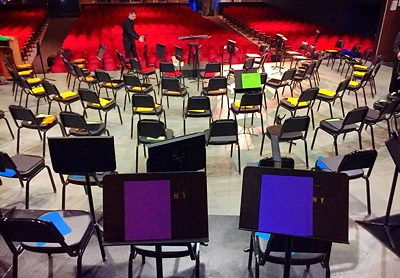
Rainbow paper in place, for the Queer Big Apple Corps
performance at Symphony Space in New York City,
A
pril 11, 2015! Photo by Brian Luke.
|
The addition of a drum set part is encouraged:
A drum set part was added to PAPER CUT in 2011. If your score and parts set does not include this part, you may download a pdf of the part below.
The drummer should feel free to add the equivalent of a rock-style drum set part beginning with an intro fill on toms starting at measure 52 that leads into a steady rock beat at measure 53 (when the instruments first enter). Additional fills can be played at phrase endings.
The part can be split between separate players on hihat, snare, and toms, but if you have a drum set handy and a solid player, that works best. Once the drummer is tied in well to the tempo and feel of the track, it helps keep the band together.
|
|
|
Rehearsal and performance suggestions:
MOST IMPORTANTLY: this is a VISUAL piece! It's VERY important that each time the musicians play the paper, unless otherwise indicated they should hold the paper VERY HIGH above their heads, so that the audience can SEE the effect! This also ensures that the paper techniques can be HEARD, since if they're played low and into the music stands, they won't have nearly the same impact!
During the paper playing sections beginning at bars 20 and 28, musicians often have a tendency to rush (no kidding--see videos below-- nearly everyone does, no matter how experienced!). Here's a helpful technique: after the group that first raises the paper above their heads to play the initial tapping figure lowers their hands to their laps before raising them again, have them subtly continue to tap the "answer" figure as the responding players do so over their own heads. This may help to keep players from rushing to the next entrance, and therefore keep everyone aligned with the track.
When the "crescendo rip" section arrives at bar 37, musicians should ham it up, and physically exaggerate the drama of tearing through the paper. Again, this is something that will look very cool to the audience, even if it seems a little odd for the players.
PAPER CUT includes some very high, sustained phrases for the woodwinds that are meant to challenge younger musicians-- but not be TOO uncomfortable. So please allow any player of piccolo, flute and clarinet to play an octave lower if they desire. Specifically, if preferable:
The piccolo and flutes can play down an octave in bars 72- 103.
The clarinets can play down an octave in bars 84-87, and in bar 95.
If desired, the musicians can use their mouths and voices to imitate and bolster the sound of the paper being ripped in measures 36-43.
Please avoid converting the performance track file to a lower quality MP3 file.
As a band director, please feel free to be as experimental and creative as you wish with this piece! It naturally lends itself to any lighting, choreography or other multimedia additions you can think of!
|
|
Suggestions for an even better performance:
The synchronization of the band with the audio track is paramount, and too often, if the percussion section diverts from the tempo, the rest of the band will naturally follow them because it's likely that they're louder than what's being heard on the stage monitors. THUS: if at all possible, please either have some or all of your percussionists wear earbuds playing back the track with the click, just as the conductor hears, or, place one or two stage monitors (playing back the track without the click) very close to the percussion section, in addition to those that face the rest of the band.
It's imperative that the volume of the track equals that of the band, to create a seamless melding of sound. However, the added "washiness" and textures of an audio track can cause the live instrumentalists to become too covered up and not sound as "present." It's recommended that the musicians should over-emphasize the dynamic and articulation markings in their parts, to ensure the most musical result.
Student encouragement:
The goal is for the track and the band to be at the same volume level, so that the audience hears them as one instrument. However this balance will never be quite as apparent to the musicians! Playing to a track that is difficult to hear is a challenge, and it helps to encourage the students by reassuring them that, like movie actors who must perform on an empty stage in front of a green screen so that effects can later be added behind them, they are the musical equivalent of these actors!
|
|
Rehearsal track playback:
Band rehearsal rooms tend to emphasize the bass frequencies in the audio track. If the playback system you use has a way to boost the treble response and somewhat lessen the bass response, please do so if desired.
A version of the audio track with a click for rehearsal and for the conductor can be obtained here
Bring Alex right into your band room:
Alex Shapiro loves to use Zoom video sessions to interact with bands! These "webhearsals" allow her to talk with the students about the origins and creation of this unusual piece, answer any questions the musicians might have, and offer them a genuine connection with a living composer. The fee for one or more webhearsals is very reasonable-- email Alex if you would like to schedule one for your band. Read more about Webhearsals and see some examples, including the view Alex loves to share, here.
|
|
PAPER WAVES!
WHIRLY TUBES!
CYMBAL CONFETTI!
|

Alex loves it when bands come up with new elements to add.
Here's an excerpt from a May 2026 performance by the students of Andrew W. Mellon Middle School,
conducted by Zachary Huwalt, beginning with a beautiful paper-waving effect,
and skipping to the end with whirly tubes and a confetti-stuffed cymbal crash!
|
ERRATA FOR PRE-2026 EDITIONS
|
|
Errata from the initial 2010 printing:
Electric bass, measure 88: raise Eb up an octave assuming that the player's instrument doesn't go that low.
Alto saxophone part at bar 35: everyone who previously (at bar 32) crumpled paper, needs a new flat sheet to rip at bar 36. So it should say "TO NEW FLAT SHEET" at bar 35, and then at bar 36 the box should read, "NEW FLAT SHEET: crescendo rip down length of paper". Delete the "TO NEW FLAT SHEET" indication at bar 38, and change the box indication at bar 39 from "NEW FLAT SHEET: crescendo rip" to "SAME FLAT SHEET: crescendo rip".
Tuba, measure 93: can be taken down an octave if preferred.
Vibes, measure 72: hard mallets will sound best.
And, if you purchased ANY copy of PAPER CUT since 2013 that has the bright green-with-orange cover published by American Composers Fourm, please check to make certain that this errata from the second 2013 edition of the piece has been fixed in your score and parts:
Tuba, m. 71: please crescendo the last two beats of the measure along with the rest of the band.
Everyone playing paper in bar 79 should also play a quarter note downbeat of paper at m. 80.
Trumpet 1: m. 86-87, please add a tie to the note (like the oboe).
Trombone 2, Cymbals, Snare, and Bass drum: m. 87, please add two 16th note paper-playing pick ups into m. 88., to match Bass clarinet and Baritone sax.
Electric bass and Vibraphone: m. 96, please add a tie into 96 to a half note, to match the rest of the band.
|
|
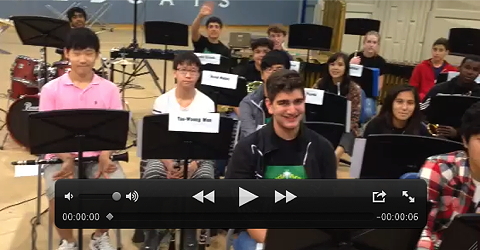
In a sweet video from Saudi Arabia,
made by band director Brian White's students in March 2014
at the Saudi Aramco Schools, the students promise Alex
that they won't rush the paper playing at bars 20 and 28!
|
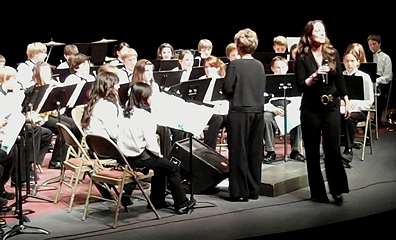
Alex addressing the audience
at the Friday Harbor, WA premiere, 5/25/10.
|
|
Enjoy a conversation between Alex and conductor Kelly Watkins, prior to the Lesbian & Gay Big Apple Corps (now the Queer Big Apple Corps) performance of PAPER CUT at Symphony Space in New York City |
 |
"PAPER CUT produces an aural and visual experience that is unmatched for music at this grade level and is easily one of the most original and interesting pieces written at any grade level in recent memory."
— Jeffrey Gershman, School Band & Orchestra, July 2013
To read the full review,
please click here
|
Alex has written an extensive two-part article about electroacoustic band music and the uses of multimedia in the concert world. The essay, titled The e-Frontier: Music, Multimedia, Education, and Audiences in the Digital World echoes the presentations she has given at the 2013 Midwest Clinic, the 2014 TMEA convention, and countless other seminars, and appears in the June and September 2014 issues of the magazine of the World Association for Symphonic Bands and Ensembles, WASBE World. The pdf is offered here with the very kind permission of the organization.
|
|
Click here for the full .pdf file |
|
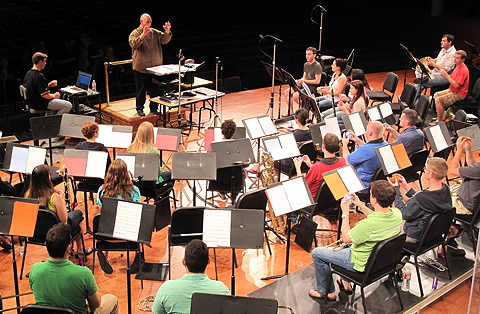
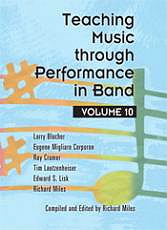
Eugene Migliaro Corporon conducting the recording of
PAPER CUT in June 2014,
for the CD included with
Teaching Music Through Performance in Band, Vol. 10.
|
 |
At the December 2017 Midwest Clinic in Chicago, Alex spoke with Sean Smith, the Assistant Director of Athletic Bands at the University of Illinois and the producer of its One More Time podcast series. The show focuses on women in the band world and features Alex describing how she came up with the idea for PAPER CUT (and proving that women are just as equally capable as men at suffering from writer's block!) |
The link to the full show, beginning with interviews with Carol Berthold, Dr. Courtney Snyder, Dr. Andrea Brown, Prof. Paula Crider, and Dr. Emily Threinen, is HERE.
|
|
You can listen to Alex's segment about PAPER CUT, HERE.  |
|
In a September 2018 podcast with Britt Burns for The Indie Classical Podcast, Alex describes how she stumbled upon the idea of playing paper in PAPER CUT:
|
|
"It means a lot to me to not only teach music, but to also teach values that I think are important. Your piece, PAPER CUT, has honestly been one of my favorites in my four years of teaching.
Not only did we create the music, but your piece opened the door for so much more. We had the age old, "What is music?" conversation. Is paper music? We created action plans about the school paper usage and recycling after bringing in a waste management professional to speak to the band. The conversation about reducing our ecological footprint is more critical than ever!
We also live in an area of Wisconsin where paper mills are everywhere. I took the students on a tour to learn about the jobs, learn how paper was made, and made our own recycled paper for the concert. The more I got into the piece, the more I wanted to teach. I could not think of another piece that can do so much, and I can't wait to teach it again very soon."
Jacob Martin
Band director, Kaukauna High School
Kaukauna, Wisconsin
|
|
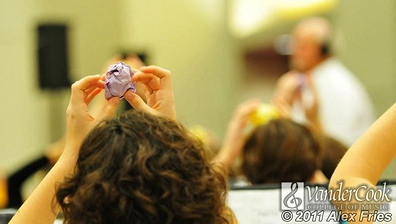
PAPER CUT rehearsal at the Midwest Clinic in 2011,
with conductor Charlie Menghini.
|
ALEX SHAPIRO DISCUSSING
PAPER CUT
|
Want to learn the paper playing techniques? See Alex explain how to be a paper virtuoso (clip length: 4:48):
|
|
|
Alex demystifies the electronic element of PAPER CUT (clip length: 1:22):
|
|
|
Alex describes the process of working with a prerecorded track (clip length: 1:27):
|
|
|
Alex describes the process of conducting to a prerecorded track (clip length: 2:09):
|
|
|
Alex discusses the inspiration behind PAPER CUT (clip length: 00:34):
|
|
|
Alex talks about what students can learn from PAPER CUT (clip length: 1:31):
|
|
|
Guess what Alex would like to do next with PAPER CUT? (clip length: 1:41):
|
|
|
And finally, to complete the exploration of All Things Paper (and give you someone to laugh with), here's something that Eugene Migliaro Corporon shared with Alex after he conducted PAPER CUT in June 2014 for its inclusion in "Teaching Music Through Performance in Band, Vol. 10" (clip length: 1:44):
|
|
|

Michael Hatstatt conducts L'Orchestre d'Harmonie
during an origami-decorated performance of PAPER CUT
in Mulhouse, France, February 2020.
|
Watch Alex work with the 7th graders at the Friday Harbor Middle school:
|
|
|
Alex speaks to the audience and introduce PAPER CUT at its Friday Harbor, WA premiere, May 25, 2010:
|
|
|
We've been collecting videos of PAPER CUT and adding them to a favorites list on Alex's YouTube channel. You can see and hear what other bands have done with the piece by clicking here.
Do YOU have an uploaded video of PAPER CUT to share? Let us know by emailing Alex: click here.
|
|
PAPER CUT was given its world premiere on May 25th, 2010 by the Friday Harbor Middle School Band, and was rewarded with a standing ovation from a packed house of over 300 people at the San Juan Island Community Theater (hey, that's a significant percentage of the tiny island's residents!). Thanks to all the students, and most of all to band director Janet Olsen!
Special thanks to Carey Nadeau, Suzanna Altman, Craig Carnahan and John Nuechterlein of the American Composers Forum for making this project possible, to Craig Kirchhoff and Jerry Luckhardt for making the recording a success, and to Thomas Duffy for his inspired vision as the co-founder and editor of the BandQuest series.
PAPER CUT was the second piece for wind band that Alex Shapiro ever composed, and the first band piece she'd ever written for student musicians.
|
|
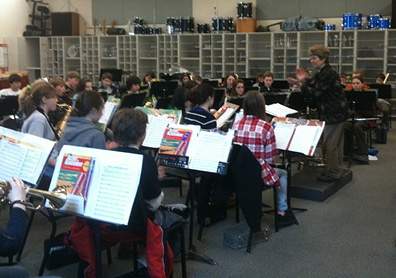
Janet Olsen rehearsing with the students
at
Friday Harbor Middle School,
San Juan Island, Washington.
|
| |
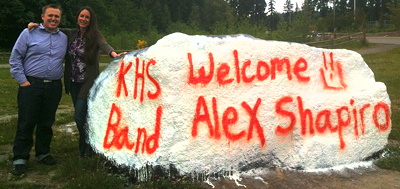
When Alex drove up to the entrance of Washington State's Kingston High School in June 2012 for her residency for their performance of Paper Cut, she was given a warm welcome by band director Adam Campagna and the students' efforts, both pictured above, thus making her a rock star-- at least for a few really fun days.
|
|
The
VERY best way to reach Alex is
through email, by clicking here
|

|
 |
There's a lot more Shapiro
band music to hear!
Head on over to THIS PAGE for an overview of Alex's wind band pieces. You can listen to each one, read all about it via a link, and if desired, request a free pdf perusal score. Have fun! |
|